
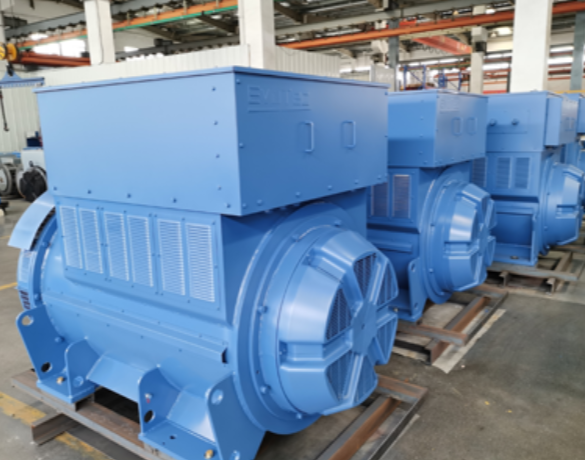
Comparative insight guides this discussion: when facilities choose between common standby units and large-capacity machines, the difference shows up first in waveform fidelity and harmonic distortion. Experience from grid failures such as the 2011 Tōhoku earthquake underscores why waveform integrity matters for sensitive loads; at the same time small-site resilience often depends on reliable rotating alternators — see an example with a 50hz generator used in many Asian installations. This article examines how standard models handle THD, voltage regulation, and transient response, and how an advanced 3000 kVA design improves on those metrics with engineered alternator and AVR strategies.
Why waveform quality matters for equipment and operations
Poor waveform equals stress on power electronics and motors. Harmonic distortion increases heating in transformers and neutral conductors, while voltage deviation harms PLCs and server power supplies. Industry terms to note are THD and load regulation; both are measurable and directly tied to lifecycle costs for gear. Designers should prioritize consistent RMS voltage and low harmonic content to protect sensitive equipment, especially in healthcare, data centers, and manufacturing lines.
Standard generator models: common limitations and expected behavior
Standard gensets often emphasize cost and simplicity. They deliver acceptable voltage under linear loads but struggle with nonlinear, fluctuating loads because of slower AVR loops and smaller alternators. Expect higher THD when variable-frequency drives or large rectifier banks are present. Service teams frequently encounter issues with frequency droop and transient voltage dips during motor starts — these are telltale signs that the set was not specified for the actual load profile.
What an advanced 3000 kVA generator changes
A high-capacity generator brings larger synchronous alternator mass, stiffer voltage regulation, and more sophisticated AVRs. The result: faster recovery from transients, reduced harmonic injection, and improved load sharing in paralleling schemes. For industrial plants with heavy inductive loads, this translates to fewer nuisance trips and longer equipment life. Designers integrate tuned filters and active control to keep THD within stricter limits, while protection settings become more selective to avoid unnecessary downtime.
Operational considerations, common mistakes, and field lessons
Installers sometimes under-spec the generator for worst-case starting currents or ignore power factor correction. The consequence is repeated overload events and overheating. I observed a 50 kva generator at a community clinic in Taichung where poor sizing led to repeated ATS cycling during typhoon outages; the clinic upgraded to a properly rated set and reduced failure incidents. — Practical checks must include measured THD under representative loads, AVR response time, and alternator coupling rigidity. Avoid relying solely on nameplate kVA when motor starting and nonlinear loads are present.
Teardown observations and practical teardown notes
During an operational production teardown I documented {main_keyword} and {variation_keyword} to capture both control-loop behavior and physical wiring practices. Common findings: undersized neutral conductors, loose alternator excitation wiring, and filter placements that were too distant from problematic loads. Paralleling interfaces are often the weak point; better synchronization modules and stiffer governors reduce circulating currents and improve waveform stability.
Comparative summary and integration advice
Standard sets are cost-effective for resistive or light varying loads. Advanced 3000 kVA units are justified when load complexity, critical uptime, or large motor starts are routine. Integration matters: power factor correction, properly sized switchgear, and coordinated protection settings yield the best returns. When a medium site upgrades from a 50 kva generator to a higher-rated installation, the immediate gains are fewer trips and more predictable THD under load.
Three golden rules for selecting generator strategies
1) Evaluate dynamic load profile: measure transient currents and harmonic content under real operating cycles before sizing. This is the primary metric that separates adequate from insufficient designs.
2) Specify control bandwidth: require AVR and governor response times that match motor-start and rectifier-induced disturbances. Faster control loops reduce voltage sag and limit THD growth.
3) Verify installation integrity: confirm neutral sizing, filter placement, and synchronization circuitry during commissioning. Poor workmanship erases specification gains.
These rules highlight where investment yields measurable reliability improvements, and they naturally point toward solutions offered by well-engineered suppliers such as EvoTec. —