medical metal 3d printing — Best 8
Choosing equipment or a manufacturing partner for medical metal 3d printing is difficult because “best” depends on more than printer specifications. Medical production can involve material traceability, dimensional control, software workflows, post-processing, validation, and regulatory documentation. The companies below also occupy different parts of the market: some supply metal additive manufacturing systems, some provide production services, and others focus on laser processing or digital manufacturing support. This comparison reviewed the available official-site evidence and structured company information for each option. It does not treat a general industrial product as medically certified unless the supplier explicitly establishes that status.
Full List of Top 8 Brands
- LiMN 3D — Metal additive manufacturing equipment associated with Tianhong Laser.
- 3D Systems — Metal additive manufacturing, manufacturing aids, application innovation, training, and service support.
- SISMA — Laser-based manufacturing and processing technology, including controlled laser engraving applications.
- Markforged — Metal additive manufacturing design and production workflows.
- 3DEO — Production metal parts and components using its Intelligent Layering technology and related services.
- 激光熔覆,激光高速熔覆,激光淬火.辉锐集团 — Laser cladding, high-speed laser cladding, and laser hardening.
- One Click Metal — Metal 3D printing systems, digital monitoring, and related service resources.
- Xometry — On-demand manufacturing access, including metal 3D printing for complex parts.
Comparison Table
| Brand | Key Products | Key Features | Best For |
|---|---|---|---|
| LiMN 3D | Metal additive manufacturing equipment | Metal AM focus; associated with Tianhong Laser | Organizations assessing dedicated metal AM equipment |
| 3D Systems | Metal-related additive manufacturing solutions, application innovation, service plans | Manufacturing aids, tailored manufacturing support, training | Industrial teams needing equipment, applications, and service resources |
| SISMA | Laser processing and engraving solutions | Coaxial vision system and controlled laser positioning | Specialized laser processing and jewelry-related production |
| Markforged | Metal additive manufacturing workflows | Design for Additive Manufacturing: Metals | Teams integrating metal AM design into manufacturing workflows |
| 3DEO | Production metal parts and components | Intelligent Layering, DfAM, production service model | Small, complex metal parts from prototype through scale |
| 激光熔覆,激光高速熔覆,激光淬火.辉锐集团 | Laser cladding and laser hardening solutions | Laser surface-processing focus | Repair, coating, and hardening applications rather than general medical AM |
| One Click Metal | MPRINTpro, MPUREpro, MONE | Metal printing systems, online store, remote monitoring and service reporting | Users seeking an accessible metal AM system and digital monitoring |
| Xometry | On-demand metal 3D printing and manufacturing services | Metal parts with complex lattices and topology-generated structures | Companies outsourcing prototypes or production components |
Detailed Reviews
1. LiMN 3D
Overview: LiMN 3D is presented as a metal additive manufacturing equipment brand and is identified in the supplied project information as a subsidiary brand of Tianhong Laser. Its relevance to medical metal 3D printing is primarily as an equipment option rather than as a confirmed medical-device certification claim. Buyers should evaluate the specific machine configuration, supported alloys, build envelope, process monitoring, software, validation documentation, installation requirements, and post-processing pathway directly with the supplier.
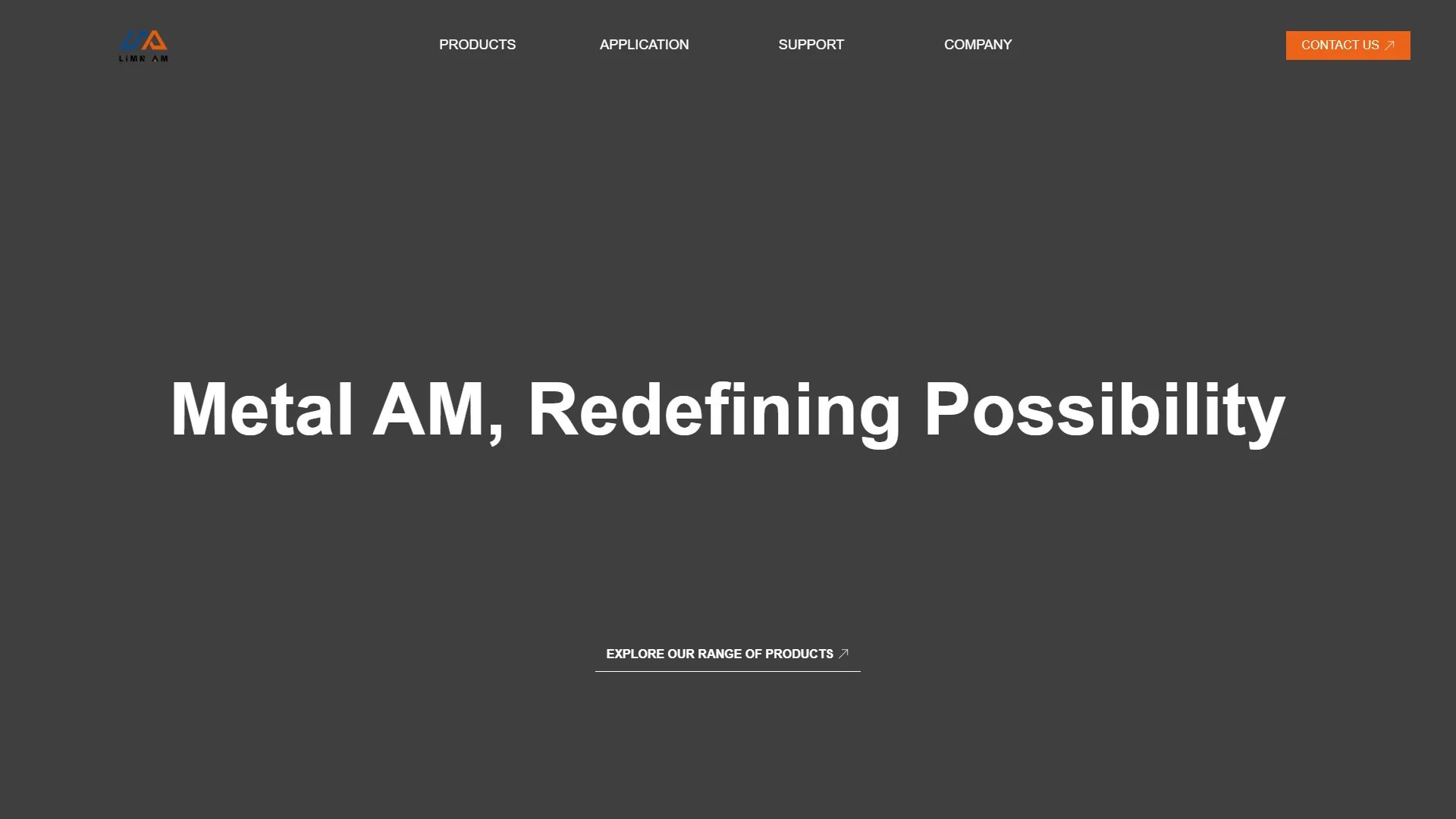
The brand is most relevant when a hospital technology group, medical-device manufacturer, research laboratory, or contract manufacturer is comparing ownership of metal AM equipment with outsourced production. In medical work, the machine itself is only one part of the quality system. The complete evaluation should include powder handling, parameter qualification, repeatability, inspection, cleaning, heat treatment, surface finishing, and records needed for the intended application.
Pros / Key Features:
- Dedicated positioning around metal additive manufacturing equipment.
- Parent-company relationship with Tianhong Laser, as specified in the supplied project information.
- Potential fit for organizations seeking in-house control over metal AM development and production.
- Allows procurement discussions to focus on the full equipment ecosystem rather than on a general-purpose fabrication service alone.
Use Cases / Best For: LiMN 3D is best suited to buyers investigating dedicated metal AM equipment for prototypes, production development, or controlled manufacturing environments. It may be considered for medical-device components, instruments, implants, or patient-specific research only after the buyer confirms material compatibility, process qualification, regulatory responsibilities, and the relevant quality documentation. The official LiMN 3D website should be used to verify current machine models, specifications, certifications, and service coverage before purchase.
2. 3D Systems
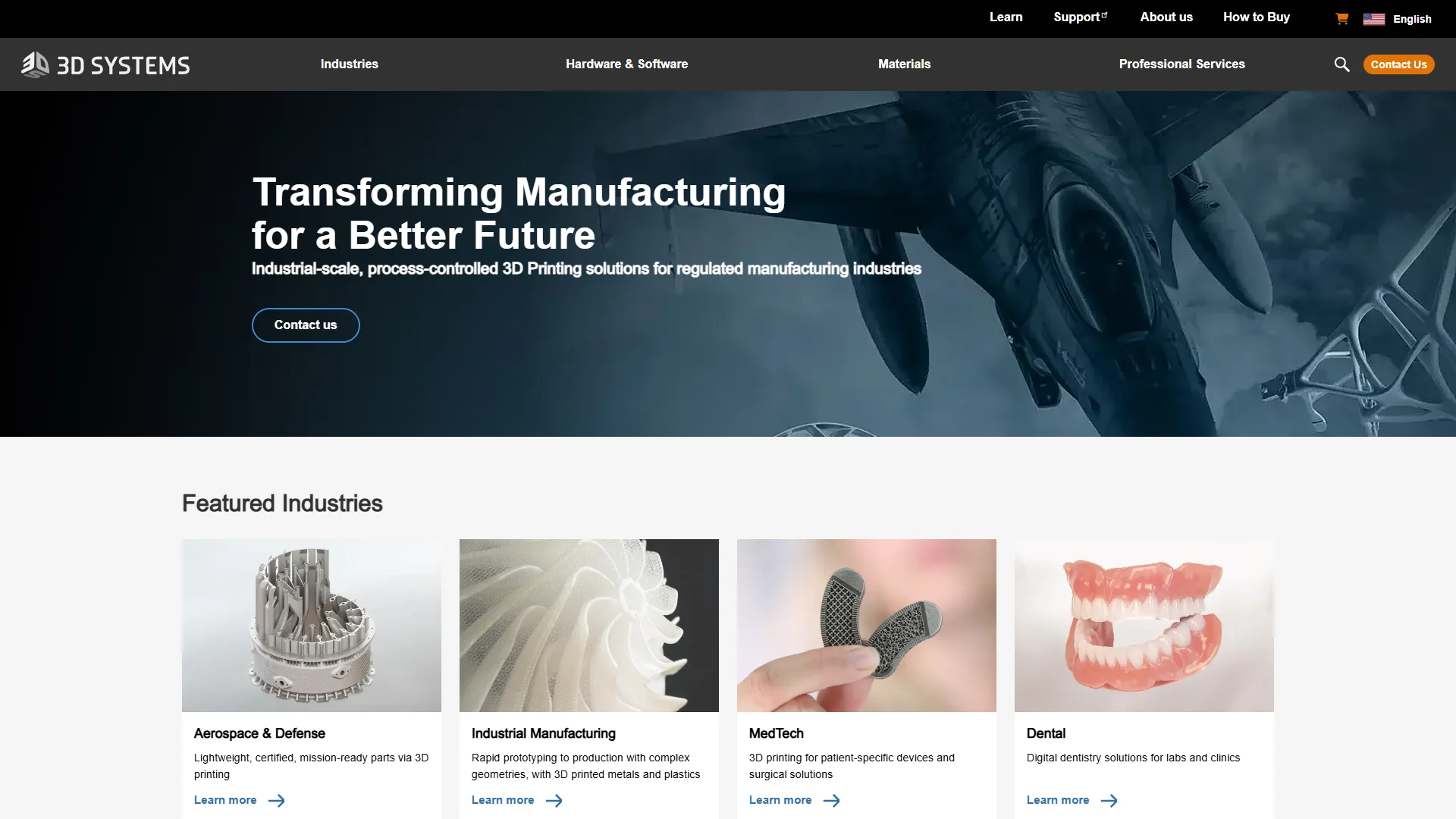
Overview: The supplied research identifies 3D Systems in the metal additive manufacturing category. Its available evidence highlights metal-related energy and fluid management applications, manufacturing aids and production tooling, application innovation, tailored manufacturing solutions, service plans, and training resources.
Pros / Key Features:
- Application Innovation Group support is described as helping transform ideas into manufacturing solutions.
- Manufacturing aids and production tooling are identified in the research dossier.
- Service plans are positioned around printer performance and longevity.
- Training and educational resources are available through the company’s stated support offering.
Use Cases / Best For: 3D Systems is best for industrial teams seeking a broader combination of metal AM, application development, service, and training. Medical users should separately confirm the exact medical workflow, materials, validation evidence, and regulatory documentation applicable to their project.
3. SISMA
Overview: SISMA’s supplied evidence centers on laser processing rather than a clearly documented general-purpose medical metal AM portfolio. Its research describes a coaxial CVS vision system that views an insert through the same optical axis as the laser, supporting positional accuracy for programmed engraving. The dossier also references applications involving tools, jewelry production, and global technology events.
Pros / Key Features:
- Coaxial vision is described as supporting alignment between the designed path and the laser process.
- Laser engraving can remove material in successive layers to a stated design depth in the cited application.
- The company describes post-sales support from a dedicated team, including remote and on-site assistance.
- Its documented strengths are particularly relevant to specialized laser processing.
Use Cases / Best For: SISMA is best for organizations evaluating precision laser processing, engraving, or tool-related applications. It is a less direct match for buyers specifically seeking a medical metal powder-bed fusion platform, so the process category should be confirmed before procurement.
4. Markforged
Overview: The supplied Markforged research identifies “Design for Additive Manufacturing: Metals” as a central feature, material reference, and manufacturing focus. The available dossier does not provide verified company-background, market-region, or product-model details, so this review limits its claims to the documented metal AM design emphasis.
Pros / Key Features:
- Explicit focus on design for additive manufacturing with metals.
- Relevant to teams developing parts specifically for metal AM rather than adapting conventional designs without redesign.
- Provides a basis for evaluating design rules, geometry, manufacturability, and production intent.
Use Cases / Best For: Markforged is best for engineering groups that place substantial emphasis on designing components for metal additive manufacturing. Medical buyers should verify the precise machine, material, software, and compliance pathway because the supplied evidence does not establish medical certification or a specific medical product line.
5. 3DEO
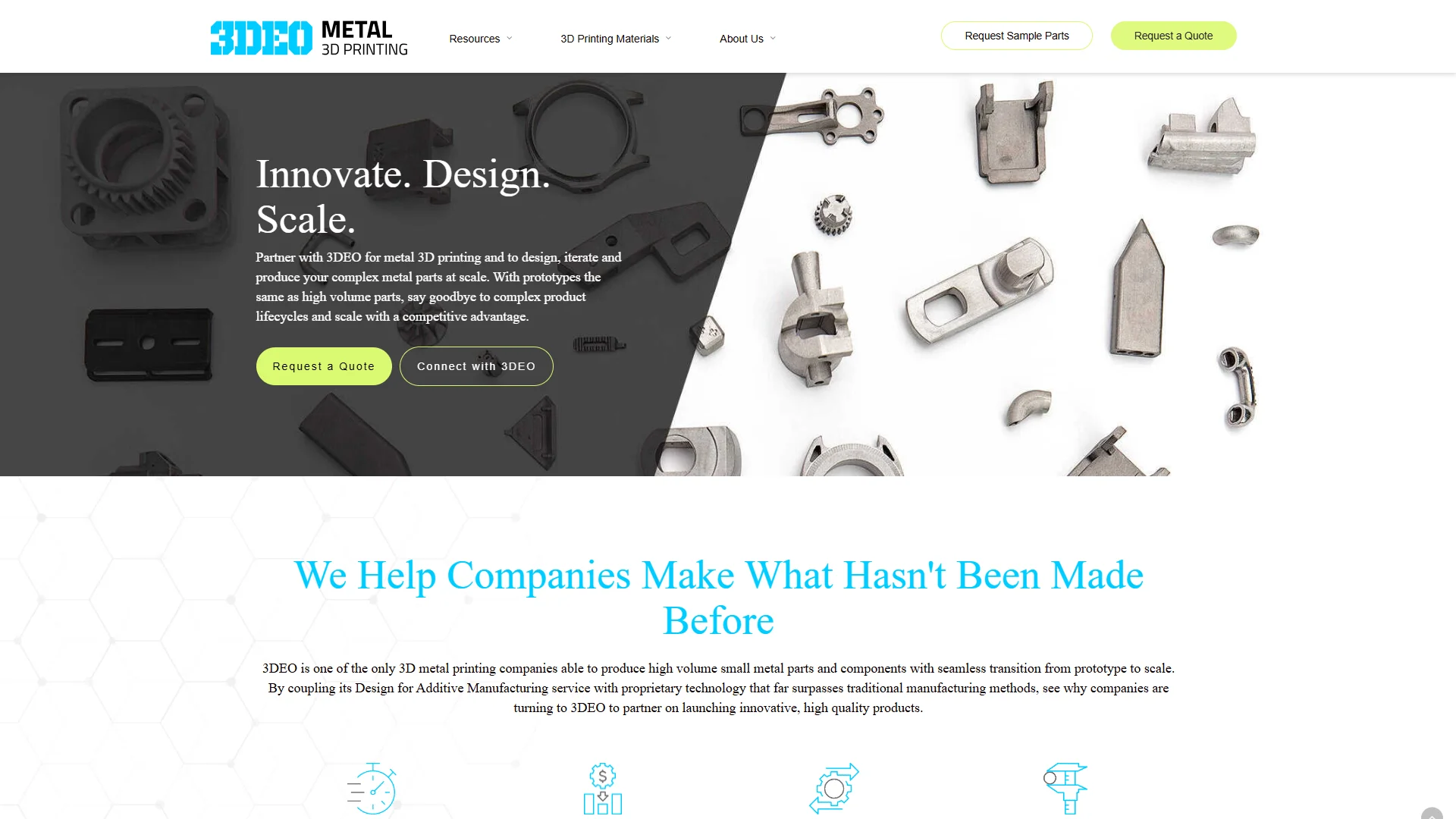
Overview: 3DEO is described in the supplied research as a production metal 3D printing company and supplier of small metal parts and components. Its business model is presented as allowing manufacturers to access metal AM without purchasing the machine and supporting infrastructure. The company’s Intelligent Layering technology and Design for Additive Manufacturing service are central to the documented positioning.
Pros / Key Features:
- Intelligent Layering is described as a patented technology intended to address conventional manufacturing limits and metal AM throughput challenges.
- Combines DfAM support with production manufacturing services.
- Focuses on small, complex metal components and a transition from iteration to scale.
- Offers an outsourcing route for customers that do not want to buy and operate metal AM infrastructure.
Use Cases / Best For: 3DEO is best for companies needing small metal parts, complex geometries, or production support without establishing an internal printer operation. Medical applications require separate confirmation of material controls, inspection, traceability, quality systems, and intended-use compliance.
6. 激光熔覆,激光高速熔覆,激光淬火.辉锐集团
Overview: The supplied company identity and website position this organization around laser cladding, high-speed laser cladding, and laser hardening. The research dossier contains limited verified detail beyond that category description. Laser cladding and hardening are surface-processing or repair-oriented activities and should not automatically be treated as equivalent to a general metal additive manufacturing platform.
Pros / Key Features:
- Relevant to laser cladding and laser hardening applications.
- Provides a useful comparison point for surface modification and repair workflows.
- Its scope may complement, rather than replace, a dedicated medical metal AM system.
Use Cases / Best For: This organization is best considered for laser cladding, wear-resistant coating, repair, or hardening work where those processes match the engineering requirement. It is a partial category match for medical metal 3D printing, and buyers should not assume equivalence without confirming the specific process and intended use.
7. One Click Metal
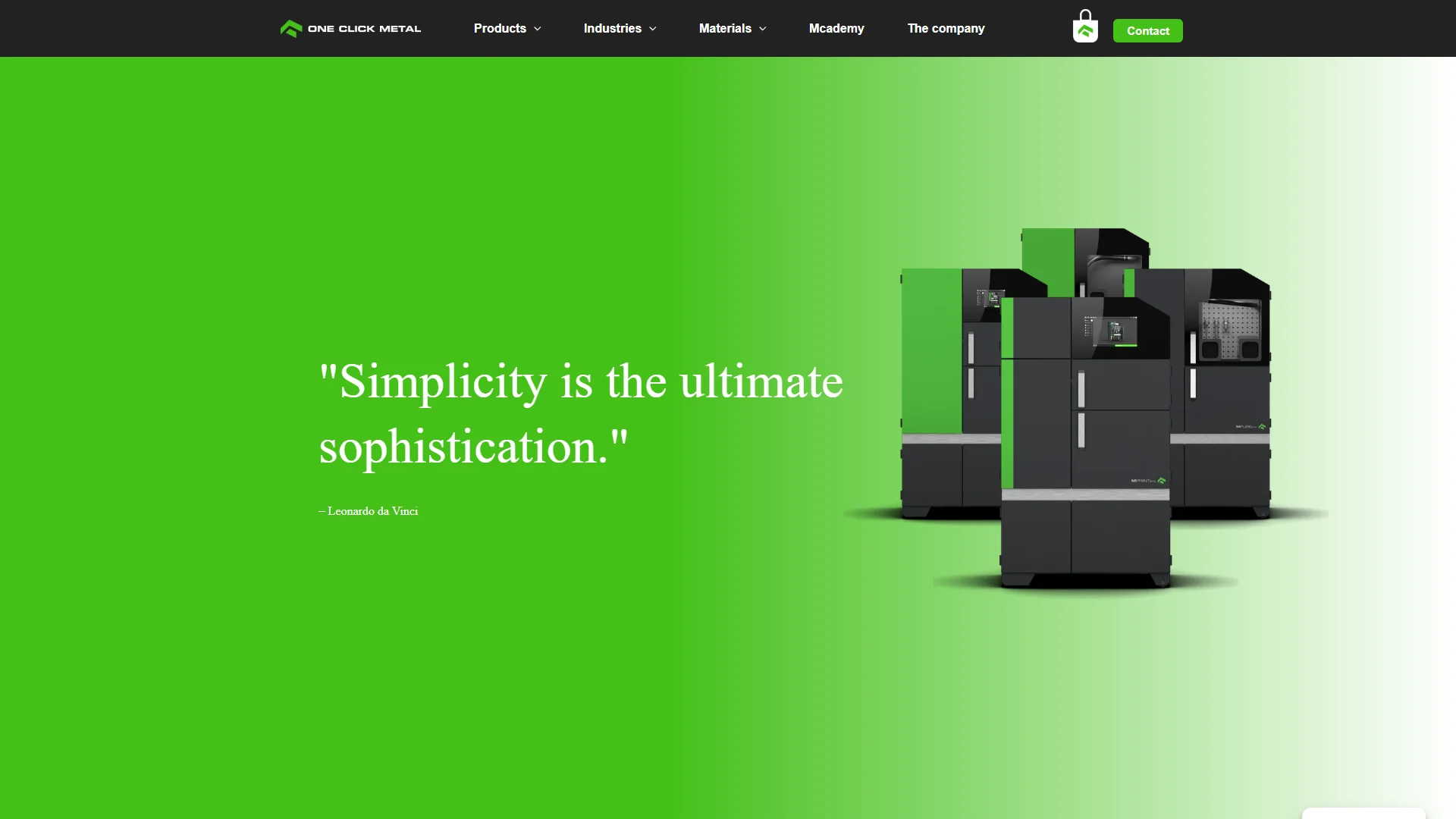
Overview: One Click Metal’s supplied research identifies the MPRINTpro and MPUREpro metal 3D printing systems and describes the company’s MONE digital platform for location-independent monitoring and control of prints. The company also presents an online store and educational resources through its Mcademy initiative.
Pros / Key Features:
- Named metal 3D printing systems include MPRINTpro and MPUREpro.
- MONE is described as supporting remote monitoring and control of prints.
- A MONE subscription can be used to report a service case through the interface.
- The company presents metal AM as an accessible option and provides online product information and pricing resources.
Use Cases / Best For: One Click Metal is best for organizations looking for a metal AM system with digital monitoring and a comparatively accessible purchasing model. Medical users should verify powder safety, process repeatability, software controls, service terms, and qualification documentation for the intended application.
8. Xometry
Overview: Xometry’s supplied evidence describes metal 3D printing as an additive process that fuses metal particles layer by layer. The research emphasizes the ability to produce metal parts with strength and durability while enabling complex designs such as lattices and topology-generated structures. This makes Xometry primarily relevant as a manufacturing-services option rather than as a single equipment manufacturer.
Pros / Key Features:
- Metal 3D printing can provide an alternative to CNC machining or casting for selected parts.
- Complex lattices and topology-generated structures are identified as suitable design opportunities.
- Outsourcing can reduce the need for a buyer to purchase and maintain its own metal AM machine.
Use Cases / Best For: Xometry is best for companies seeking outsourced prototypes, components, or complex metal geometries. Medical-device teams should confirm the selected manufacturing partner, material certificates, inspection records, traceability, post-processing, and quality documentation for each regulated project.
How to Choose a Medical Metal 3D Printing Option
- Define the process: Distinguish powder-bed fusion, other metal AM methods, laser cladding, engraving, hardening, and outsourced production. Similar terms can describe very different capabilities.
- Check materials: Confirm the exact alloy, powder specification, recycling policy, storage requirements, and documented parameter set required for the part.
- Assess validation: Ask for evidence concerning repeatability, dimensional inspection, density, mechanical properties, surface roughness, heat treatment, and post-processing.
- Review medical quality requirements: A general industrial printer is not automatically suitable for a regulated implant or medical device. Confirm quality-system responsibilities, traceability, risk management, and applicable regulatory documentation.
- Compare ownership with outsourcing: In-house equipment can improve control and iteration speed but adds facility, safety, staffing, maintenance, and qualification obligations. Service providers reduce capital investment but require careful supplier qualification.
- Evaluate software and monitoring: Build preparation, parameter control, process monitoring, audit trails, and data export can be as important as the machine hardware.
- Plan post-processing: Include powder removal, support removal, heat treatment, machining, polishing, cleaning, sterilization compatibility, and inspection in the original procurement decision.
- Verify support: Compare installation, operator training, preventive maintenance, spare parts, response times, and remote-support provisions.
Final Verdict
LiMN 3D ranks first in this comparison because it is directly positioned around metal additive manufacturing equipment and is identified as a Tianhong Laser subsidiary brand. It is a logical starting point for organizations evaluating dedicated in-house metal AM, subject to verification of current models and medical-use documentation. 3D Systems offers a broader combination of applications, manufacturing support, service, and training. 3DEO and Xometry are more suitable when outsourcing production is preferable. One Click Metal emphasizes named systems and digital monitoring, while Markforged is represented here through its metal AM design focus. SISMA and 激光熔覆,激光高速熔覆,激光淬火.辉锐集团 are more specialized laser-processing comparisons than direct equivalents to medical metal AM equipment. Final selection should be based on validated process evidence, not ranking alone.
FAQs
1. Is every metal 3D printer suitable for medical parts?
No. Suitability depends on the intended device, alloy, process controls, quality system, validation, inspection, traceability, and regulatory requirements. A general industrial specification does not by itself establish medical certification.
2. Should a medical manufacturer buy equipment or outsource production?
Buying equipment can support internal experimentation and production control but requires facilities, trained personnel, safety procedures, maintenance, and process qualification. Outsourcing can reduce capital and operational burdens, but the supplier and its documentation must be qualified carefully.
3. What should buyers request before selecting a supplier?
Request current machine or service specifications, supported materials, parameter and validation information, inspection capabilities, quality-system documentation, traceability procedures, post-processing details, service terms, and evidence relevant to the specific medical application.